
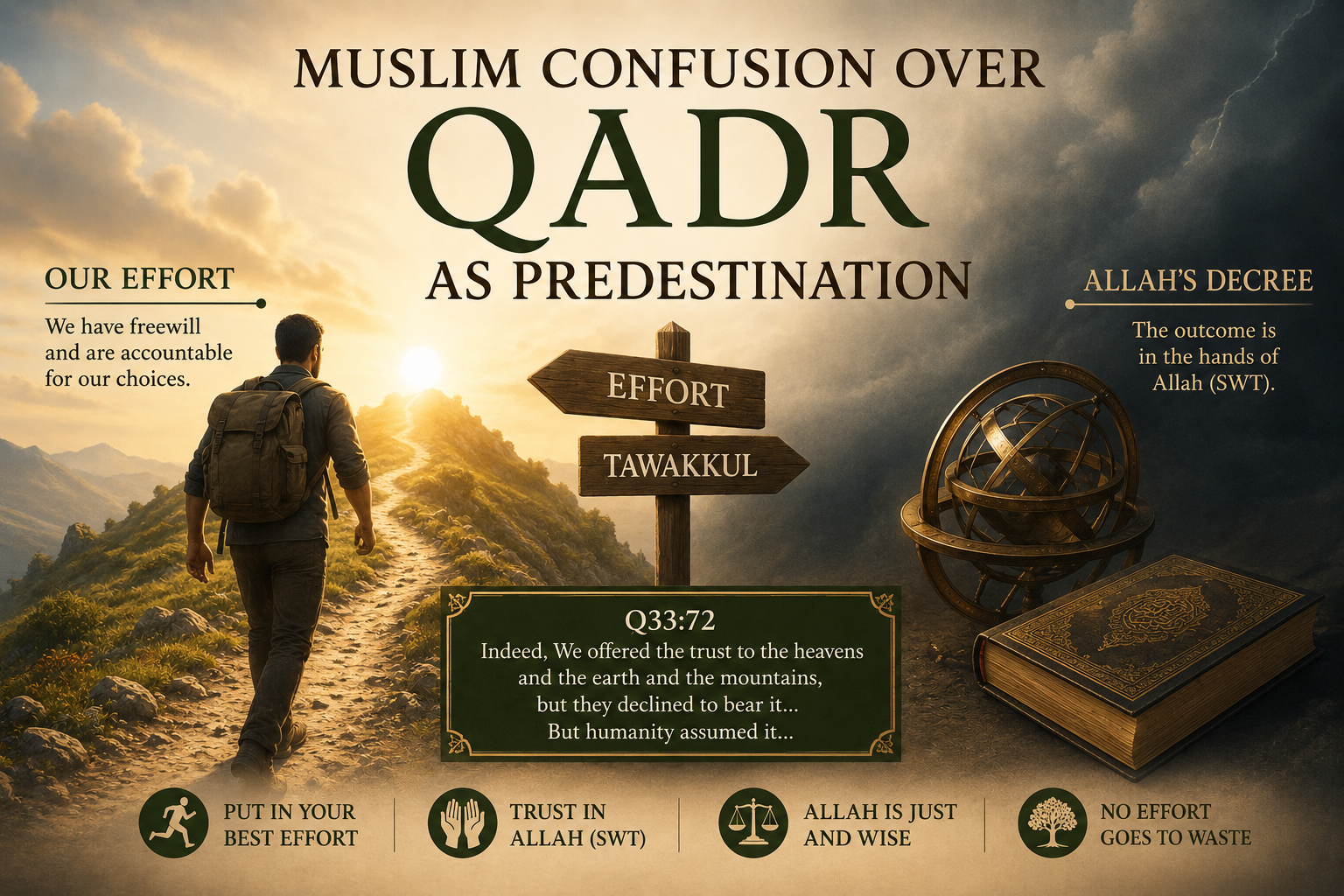
Our Creator Allah SWT not only created us but gave us the honor of being His Vicegerent (Khalifa) in this world according to Quran 2:30. The main feature of this vicegerency is the limited freewill we humans have been given as a trust that Allah SWT mentions in the following verse,
Q33:72 – Indeed, We offered the trust to the heavens and the earth and the mountains, but they ˹all˺ declined to bear it, being fearful of it. But humanity assumed it, ˹for˺ they are truly wrongful ˹to themselves˺ and ignorant ˹of the consequences˺,
The answer to whether human beings have any freewill is absolutely clear in Quran. However, the same Quran also mentions the ‘Qadr” which is often translated as pre-destination and explained as everything has been predestined in each of our lives. Let us try to understand this dichotomy in the light of Quran and how misinterpretations occurred in historical context. Much of this article is taken from my book “The Great Disconnect between Islam and Muslims”.
Islam is anything but a passive submission. This submission in Islam is very active and requires full participation in every aspect of life, where we are expected to give our very best effort before submitting to Allah (SWT), who is the sole determinant of the results of this effort. With Allah being fair and just, He will not let any of our efforts go to waste. Even if that effort does not bear the exact result we wanted, it will bear fruit in the long run and make our next effort more effective. This Tawakkul, after putting in the best effort, allows us to move forward in life without being stuck, dwelling on the past, and getting depressed.
Somewhere along the way, the Ummah lost its way and coalesced around the concept of complete predestination. They have taken the word Qadr and translated the word as predestination. An active Submission was passivized by those who misunderstood Qadr.
The concept of Qadr is one of the most misunderstood phenomena in the history of Islam. People have bent themselves into pretzels trying to twist the meaning to what they would like to see. As always happens, the meaning that was beneficial to the powers of the time got more publicity and hence acceptance. Propaganda or misinformation is not an invention that came with social media. It has existed since humanity came together in large social circles, such as cities and schools. From the time of the early Umayyads, it was deemed by the powers to be that if the people believed in predestination, the rulers could get away with murder, which they literally did. When you have the entire religious institution and its teachers, Imams, and scholars on your payroll, it is not very difficult to promote a certain school of thought. The real well-meaning companions of the Prophet (SAWS) were sitting sidelined in Medina, disengaged from the disgusting politics.
Hence, Predestination was promoted and propagandized actively, and it became the standard belief among Muslims. I am sure that even in power circles, there were people who did not agree and may have even written or spoken out against it. It is simple to imagine how easy it was to muffle their voices, prevent their writing from coming out, and eventually eliminate them if they did not get the point. If anyone doubts that, I would remind them of the Mihna (inquisition) and the counter-Mihna during the Abbasid dynasty.
According to one count, the word ‘Qadr’ and its derivatives appear 132 times in the Quran. It has a range of meanings depending upon the context, and these meanings include: to have power, to restrict, control, measure, to determine, to plot, decree, ability, appraisal, estimation, etc. Of these and some other verses, the proponents of Predestination use a few to prove their point. I will mention four of the most frequently used verses, which they (mistakenly) believe are the strongest evidences pointing towards their definition of Predestination.
Quran 14:4: God misleads whom He will and whom He will He guides.
Here, the translation of the word “YuDhilloo” is wrong. It is not an active verb in Arabic grammar but a passive form of the verb. God does not mislead people, but God lets those who are misled be misled. The correct translation should be “So, Allah lets go astray whom He wills and guides whom He wills”. This confirms our belief that efforts are up to us, and the results are in the hands of Allah (SWT). It does not point to a sealed fate in which human beings are no more than passive subjects to God, misleading them. God, who sent prophets and messengers to guide people, does not mislead people! In both cases, however, human freewill remains free to make the choice for which he/she will be held accountable on the final day of judgement (Yaum al Qiyamah)
Quran 9:51: Say “Nothing will ever befall us except what God has destined for us. He is our Protector.” So in Allah let the believers put their trust.
This is in the context of hypocrites (Munafiqoon) who made excuses to not go with the true believers to defend against an enemy attack. The next verse clarifies what is meant by “anything befalls us”; it is either victory or martyrdom. There is no debate on whether it is the outcome of this battle or the result of any effort, it is determined by Allah (SWT) in His infinite wisdom. When we stand up to fight, there is a possibility that we may win or we may lose. But if we do not fight, there is no chance of winning unless there is miraculous help, and Allah does not go around doing these miracles for people who are cowards or lazy, because He is Al-Adl (The Justice) and does not give preferential treatment. Hence Allah SWT advises the Prophet to tell them that the fighters are at peace with whatever Allah destines for them individually and collectively. Here again, the word Qadr is not used in the sense of a predestined, sealed fate but a consequence of our choice.
Quran 2:6-7: As for those who persist in disbelief, it is the same whether you warn them or not—they will never believe. Allah has sealed their hearts and their hearing, and their sight is covered. They will suffer a tremendous punishment.
Please note here that the verse starts with “As for those who persist in disbelief”, which means this verse refers to those people who have been given the message of truth, but they have repeatedly denied it. By doing so, they would incur the wrath of Allah (SWT) in the hereafter and in this world. In this world, Allah (SWT) says He has sealed their heart, their hearing, and their sight as a punishment for their persistent denials, and then in the hereafter, they will suffer a tremendous punishment. Allah (SWT) intends to guide every human to success in this life and the hereafter. He does not misguide nor seal their hearts and faculties to prevent guidance if they want to be guided. I am not sure what kind of God these people believe in if they think that Allah (SWT) prevents people from being guided by the message He Himself sent for the welfare of humanity.
Quran 54:49: Verily, We have created all things with Qadar (Divine Preordainments) of all things before their creation as written in the Book of Decrees.
This is the part where most of us trip and start thinking that everything is predetermined, regardless of our efforts. The true meaning of the word Qadr here is measure or proportion, as translated by many scholars. It is not predestination in the sense as explained by some. First of all, it is important to understand the limited personal free will we are given as human beings. I was listening to a “scholar” rail against free will by asking if we have free will, can we stop the rain, or cause the rain? Then he goes on to ask if that is too big, can we cause one hair to grow quickly on our face? If we cannot even do that, how can we claim to have free will? The answer is no, we cannot make any of those things happen, and it is only in the hands of Allah (SWT).
However, if we believe Allah (SWT) compels all decisions made by us, what are we going to be held accountable for? Why would we be punished for things that Allah (SWT) decided for us? There are indeed a few things that are within the range of our options, and our accountability is for the choices we make. Allah (SWT), being the ultimate omniscient, knows about what choices we will make beforehand, but let us not misunderstand His foreknowledge as compulsion for us. Allah does not take away our freedom of choice and then hold us accountable. It goes against His sense of fairness and justice.
Most importantly, Allah (SWT) says that He is placing on earth a vicegerent (Q2:30), which implies we are the deputy or representative of Allah (SWT) on earth. And what qualifies us for this special status? It is answered in the verse that immediately follows this verse. In the next verse (Q2:31), Allah (SWT) states that we were given the ability to learn and gain knowledge by being taught the names of all things.
The meaning of the word “Amana” in the first verse quoted above from Q33:72 is trust in this context. Why does Allah (SWT) call this trust? It is because He has granted us the ability to make our own choices, and He trusts that we will make the right ones. So why not call this free choice instead of free will? In my opinion, the word “choices” does not take into account the creative capabilities of human beings and is too restrictive.
When we try to solve a problem, we not only have the choices of A, B, or C, etc., but we also have the ability to create a new option that was not on the table before. Hence, I prefer the term limited personal free will. It is limited because we as humans do not choose whether to be born, when to be born, or where to be born. We cannot choose our parents or their social status or race. Nor can we choose the genetics that we inherit.
But with all these limitations, we have the freedom to do what we want within those confines. I may have the will to play in the NBA, but with my height, it is improbable, if not impossible. I may have liked to be born in a palace to a king, but Allah (SWT) decided that I would be born to a working-class family. So, when I stand in front of Allah (SWT) on the day of judgement, my accountability may not be as big or complex as that of the head of a state. But it will certainly be more difficult than the accountability of a boy with limited resources born in a remote village in Africa, who lived there all his life, and died there. Hence, our questioning and accountability are likely to be in proportion to the number of choices our station in life affords us. More power means more choices, and that means more to account for and hence more questions to answer.
Now we can see the complete picture. We are chosen as the vicegerents (khulafa – plural of khalifa) of Allah (SWT) and were given the ability to acquire knowledge and hence wisdom, then we were given the responsibility of Amana (exercise of our limited personal free will), and we are going to be judged based on how we use it. To believe in complete helplessness and throw our hands up in despair at everything and say if Allah (SWT) wills it will happen, is nothing short of abject dereliction of our duty as the vicegerent of Allah (SWT) in this world. And we will indeed be called to account for making that choice.
Now let us explore it from a different perspective: the human perspective. As with many Arabic words used in the Quran, there is no direct English translation of Qadr. Many languages have words like this, which can mean several things and cannot be translated accurately outside of a specific context. For example, the English word “cast” could have more than a dozen meanings depending on the context. Similarly, the term Qadr can mean control, measure, power, estimate, restriction, or divine decree, among other things. However, Qadr is often translated as predestination, which is an inadequate and often misleading translation.
Let us examine the concept of Predestination as understood by the Muslims. First of all, since Qadr is an article of faith (Iman), an overwhelming majority of Muslims believe in it. However, there is a very high likelihood that Qadr, as they understand it, is “predestination.”
According to a Pew Research poll (in The World’s Muslims: Religion, Politics and Society), when asked if they believe in predestination or fate, more than 90 % (some as high as 98%) of Muslims in most Muslim countries answered in the affirmative. In fact, the more observant a Muslim is, the higher the likelihood that he or she believes in fate or predestination.
This understanding of Qadr as fate, predestination, or “kismet” has a huge impact on all decisions Muslims make in their lives. It could change the mindset of a Muslim from an active agent taking control of things they can control to a more passive attitude, which relies more on supplication to God to change their fate. As we explored earlier, the passivity of the Ummah was highly encouraged by the early rulers of the Muslim world, as it made ruling them much easier. Instead of standing up and fighting against injustice, they were more likely to accept injustice as fate.
We also discussed how God mentions in the Quran that humans accepted a covenant, which is the free will, and they will be held accountable for it on the Day of Judgment. I would not be a Muslim if I did not believe in the absolute power of Allah (SWT) over everything. But I also know that as the vicegerent of God on earth, I am endowed with a certain amount of limited free will that God Himself gave to all humans. The question that is often asked, but not adequately answered, is how these two concepts, Qadr and free will, square with our lives and the Day of Judgment. Many have tried to answer this in their own way, and it often requires some assumption of faith. Below, I will attempt to offer an answer that is purely and simply based on reasoning.
Let us start with the easy part. As humans, we have no control over many aspects of our lives. We have no influence on when and where we are born, who our parents are, when and how we will die, what skin color we have, or how tall we are, etc. And we know these things play a major role in determining the life we may have. However, these are completely out of our control. But there is someone who controls all those things and more: it is God. After a certain age, we gain the ability to control certain aspects of our lives, such as how hard we work in school, how much effort we put into our work, and how honest and sincere we are with others. This is what I call the “limited free will” that we are granted by God Himself.
But just because I worked hard on my project, am I guaranteed success? Just because I studied hard, am I guaranteed straight A grades? The answer to that is most likely that success and grades will be proportional to the effort we put in, but there is no guarantee. After all, I may still fall sick or get into an accident on the day of the exam, or the exam may be canceled entirely, and everyone will be given a passing grade regardless of their performance capabilities (as happened during the COVID days). My project, which I worked hard on at my job, gets cancelled or fails due to reasons beyond my control. However unlikely these things are, they are still a possibility.
Similarly, if I intend to do something evil like robbing a bank, and I put in my best planning, there is an above-average possibility that I will succeed with good preparation and planning, but no 100% guarantee. There may be an undercover cop in the bank, and I may end up getting killed. Hence, just because we intend to do something and make a sincere best effort to do it, we still do not completely control its manifestation as we imagine it. That manifestation is still in the hands of God. However, one thing I can be 100% sure of is that I will certainly not succeed if I do not try or put in sincere effort.
Hence, we see that things well beyond our control may determine the result of our best efforts. The good news is that while this world may judge me entirely on my results and success, Islam teaches that I will be judged by Allah (SWT) on my intention and effort. Hence, my true reward is awaiting me in the hereafter from the just God who never denies me the tiniest good I may intend or do and holds me accountable for the tiniest evil I do.
As humans, we always reserve the option to act upon something, and if we do act, we determine what that action will be. We discussed above that not taking action is also a decision, but it is a decision that will likely ensure the status quo. As the Prophet (SAWS) reminded us in Hadith 49 of Sahih Muslim, we are expected to prevent injustice through our actions if possible.
If we do not have that ability to prevent injustice with our actions, we should speak out against that injustice, and if we cannot even do that, we should at least think in our hearts that it is an injustice, and it is wrong. The last option is deemed the weakest form of faith (Iman). So, these days, when we see protests by students against the genocide of Palestinians in Gaza, we should never ask the question: What impact will it have on the brutalities continuing in Gaza?
If you do not have the ability to protest, at least speak out against injustice and help those who are protesting. You will not be asked by God why you did not stop it, but you will certainly be asked what you did to try to stop it. If the answer is ‘I did the best I could,’ you will have an easier time with at least one question on the day of judgment.
Let us step back and take note of something from the above discussion. Our limited free will does not have the ability to stand in opposition to God’s will. However, if we align our free will with God’s will, we can become agents of positive change for ourselves individually and for the Ummah collectively. On the other hand, if we exercise our free will in opposition to God’s Will, He may simply prevent it from manifesting itself while holding us accountable for our rebellion. That does not mean that God will always prevent the manifestation of evil. He may allow it in a way that ultimately serves His will. What we perceive as horrible may have consequences that ultimately lead to positive changes in the long run.
For example, the number of Americans who saw the hypocrisy of Israel and US support of it has increased exponentially, as has the number of reverts to Islam since the genocide began in Gaza. As for the victims in Gaza, they will be served justice with eternal paradise. It may even serve the purpose of jolting the Ummah out of our collective slumber, Insha’Allah (God Willing).
What we have learned is that, despite our best efforts, the results may not materialize due to worldly things beyond our control. And sometimes God directly intervenes to stop the manifestation of our intentions and plans, as He did when the Quraish planned and tried to assassinate Prophet Muhammad (SAWS), but they failed. However, they are also held accountable for their intentions and efforts even though they failed.
This belief in Qadr can be summarized by stating that God is in absolute control of everything that happens in this world, whether those occurrences are due to human effort or natural phenomena. Our individual and collective success and failure are directly dependent upon our effort, which is also the only thing we can control. That effort may succeed with God’s will, and hence we say ‘Insha’Allah, but only after putting in our best and sincere effort. Then we submit completely to the Will of God, whatever the outcome, thereby fulfilling our role as good Muslims and achieving true peace within and around us.
Hence, the Qadr is not a passive submission, but an active effort to the best of our ability and then be at peace with God’s decision whether it is success or failure. Because even if it is a failure in this world, we will have the reward waiting for our good intentions and efforts in the hereafter. By taking a passive and lazy approach, we are not affecting or postponing Gods work. His plan continues with or without us. His work always gets done, either by us or by others. When we are left out of participating in God’s work, we are deprived of the blessings of God and fall into the state of helplessness. With our current state of ignorance and laziness we are deprived of the blessings of Allah SWT and hence we are helpless even to protect ourselves from the hyenas of the world.