
Allah SWT says in Quran 21:107 “We have sent you (O Prophet) only as a mercy for all the worlds. That should be everything we need to know about our beloved Prophet (SAWS). There is however another special role that the Prophet (SAWS) played for the benefit of the Muslims. He lived his life as a human being in a way that exemplified the application of the Deen of Islam. This is so that no one could say that living the life of a Good Muslim is not possible for mere mortals. Hence we see in the life of the Prophet (SAWS) many instances of superhuman effort, tremendous patience and extreme forbearance. At the same time, we find many instances where he showed vulnerabilities and fallibility of a human being. However, when it came to Quranic revelations, Islamic teachings and religious commands he was guided by Allah SWT to be infallible and error free.
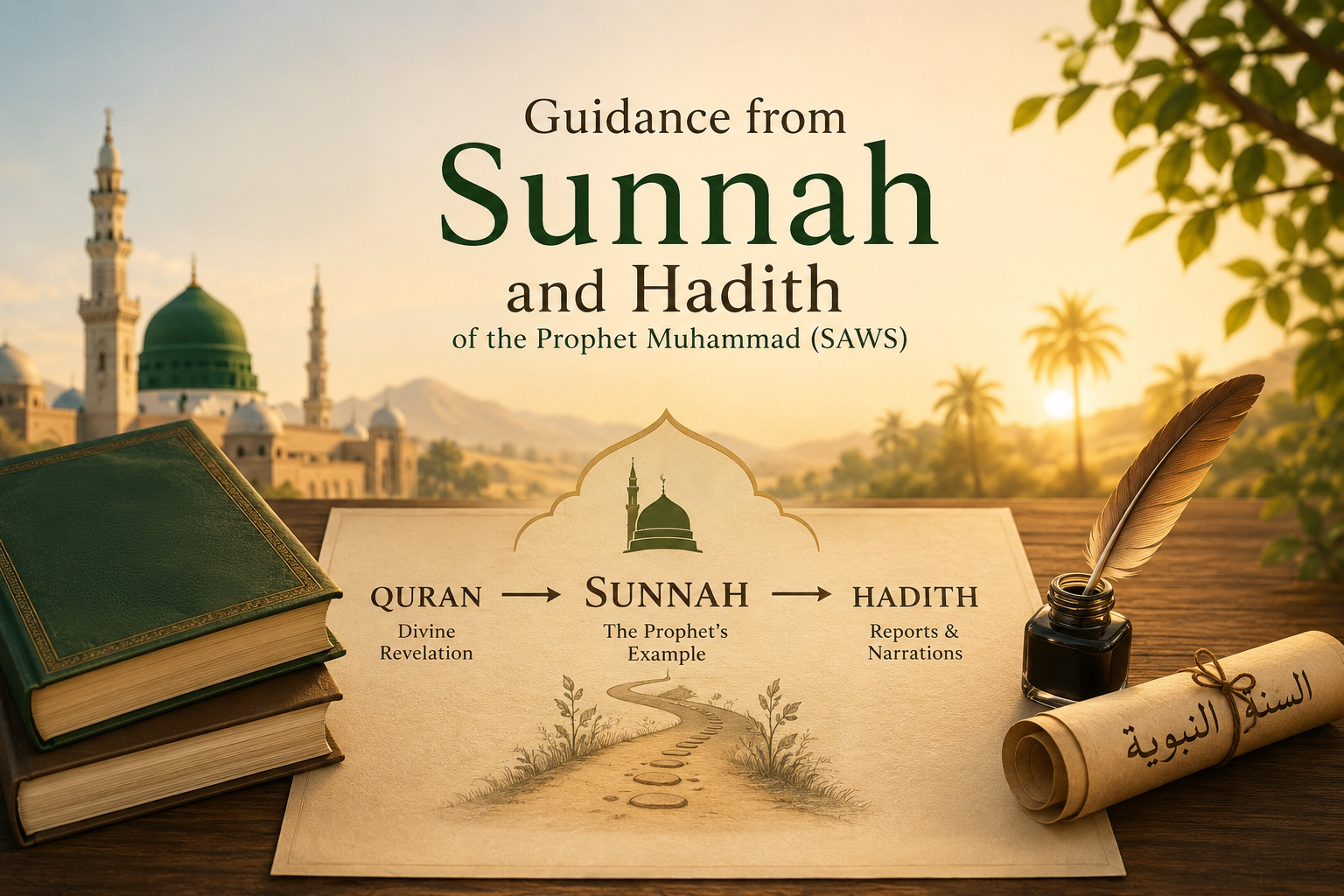
The study of Sunnah and Seerah [biography of the Prophet (SAWS)] is an important source of understanding how to apply the Quranic commands and the Deen of Islam in our lives. It is a common mistake to confuse Sunnah with Hadith. Sunnah is literally translated in Arabic as a well-trodden path. Hence Sunnah is the aggregate pattern of Prophet’s (SAWS) normative habits, actions and silent approvals. Hadith on the other hand are reports of isolated narrations, actions or incidents in the life of the prophet (SAWS).
Sunnah is like how I or my brother knows my mother by seeing her throughout her life. We were witnesses to her values, her compassion, her character, her kindness, her attitude towards life and her likes and dislikes as she lived her life with a zest. While Hadith is like my neighbor either witnessing, listening or eavesdropping on occasional speech, statement or short conversation without complete context to it.
While there is a good chance that a particular narration or conversation of my mother reported by a neighbor is accurate, that does not make the neighbor a more trusted source of her life and her values than my brother who spent a good part of his life with her as a son. If a neighbor reported her saying on a couple of occasions that she had not spoken to her cousin in years and then extrapolates that information into a pattern claiming that my mother was an introvert. That goes against everything my brother knows about his mother whom he witnessed all his life being the person to reach out to all her relatives almost on a weekly basis. Who do you think is more qualified to give a more accurate report of who my mother was? The neighbor who recorded a few instances of her life or my brother who lived with her.
That is the mistake we are making as an Ummah. Since Ahadith are recorded and compiled with bits of information, perhaps easier to recall and remember, we tend to string together a pattern and a value system for the prophet SAWS. Whereas the Sunnah of the prophet is more understood and less documented and it does not get as much attention. We forget that one place where we can learn about the Sunnah of the Prophet SAWS is the Quran because he (SAWS) was born to embody the guidance and values Allah SWT sent in the Quran. Once we get to this point then there are only two choices left. One is to review all reported Ahadith against the undeniable word of Allah SWT in Quran and reject those Ahadith that contradict Quran. The second choice is to deny or at least question the following verse in which Allah SWT reminds us that Prophet Muhammad was sent as an example for all of us,
Q33:21 – Indeed, in the Messenger of Allah you have an excellent example for whoever has hope in Allah and the Last Day, and remembers Allah often.
Sunnah is much more comprehensive biography of a person’s life including the value system and character while Ahadith are snapshots of a given situation and how the person reacted or what the person said on the occasion. I would much rather rely on the biography of the person I would like to emulate instead random snapshots reported in Ahadith filled with innocent and malicious human errors. Even if I choose to use Ahadith as reference I will make sure that these do not contradict the indisputable Quran and Sunnah. I hope this clarifies why Quran and Sunnah supersede Ahadith.
From the above it should be clear that our main source after Quran for guidance is the Sunnah of the Prophet (SAWS) and not Ahadith which were recorded more than 150 years after the life of the Prophet (SAWS).