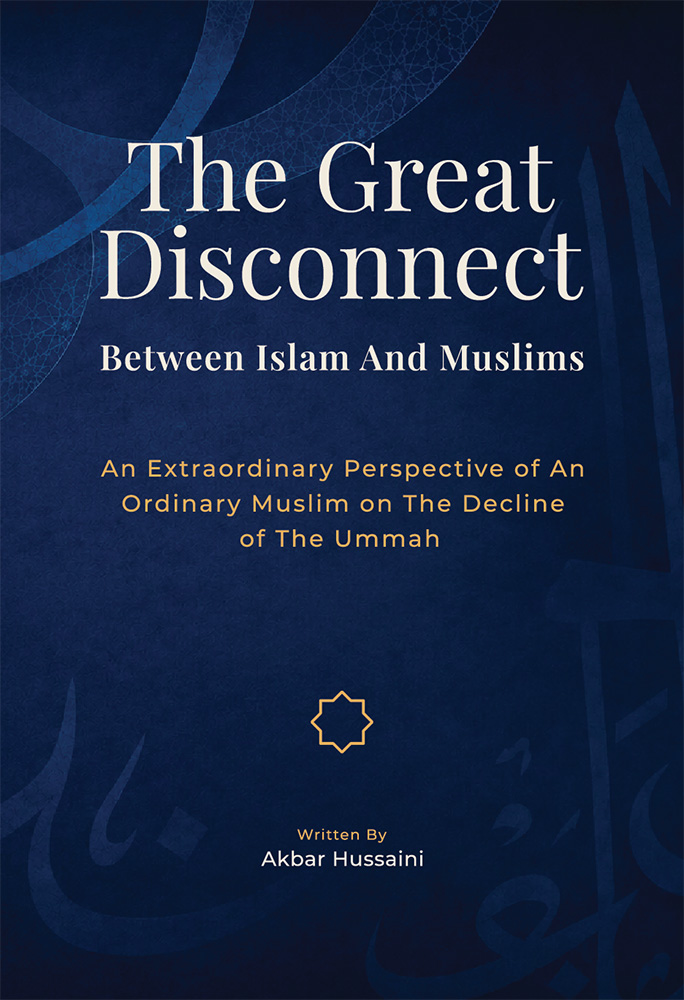
The Great Disconnect
An extraordinary perspective of an ordinary Muslim on the decline of the Ummah — exploring the gap between the perfection of Islam and the imperfect way Muslims have understood, practiced, and applied the Deen throughout history.
Islam is perfect. Muslims are not.
The central idea
The Great Disconnect begins with a simple but important distinction: the Deen of Islam is complete and perfect, but Muslims, as human beings, are fallible.
The purpose
The book does not seek to attack Islam or assign blame without purpose. It aims to identify where Muslims drifted from the ideals of Islam so that meaningful correction can begin.
A serious reflection on the condition of the Ummah.
Many Muslims today feel the pain of the Ummah’s condition but struggle to understand how we arrived here or where correction should begin.
The Great Disconnect argues that meaningful change begins with honest self-examination. Before Muslims can correct institutions, leadership, politics, or society, we must first understand the ideals of Islam and compare them honestly with our own conduct, assumptions, and inherited practices.
The book calls readers to begin with themselves, their families, and their communities — returning to the guidance of the Quran and the Sunnah with humility, courage, and sincerity.
What the book explores
The book guides readers through key questions about Islam, Muslims, history, decline, and correction.
The ideals of Islam
What are the true goals, intentions, and ideals of the Deen of Islam for humanity?
The early Muslims
How close did the early Muslim community come to living those ideals?
Human weakness
Where did ego, corruption, and human folly begin to affect the Ummah?
Historical mistakes
What major mistakes contributed to the decline from earlier heights?
The way back
How can the Quran and Sunnah help Muslims find their way back?
The urgency today
Why is the process of Tashih more urgent today than ever?
The book "The Great Disconnect Between Islam and Muslims" was not written to just identify the mistakes or even put the blame. Identifying the mistakes, misunderstandings and misinterpretations is the first step. The next logical step is to correct these mistakes. Tashih.org is that platform where th like minded Muslims come together to start the process of self-correction. We identify how these mistaken beliefs apply to our personal lives and make conscious corrections. Then we try to get our own family on track toward self-correction. Please click below to explore the platform and join the movement if it appeals to you.